The rule that saves the most sulfur: C4 for walls, explosive ammo for doors. Of the explosives you can research, a Timed Explosive Charge is the cheapest way through stone, sheet metal and armored walls, while Explosive 5.56 Rifle Ammo is the cheapest on every door, hatch and wooden target, at the price of time and noise. Rockets are never the cheapest option on paper, but you fire them from cover and nobody has to stand at the wall.
Every count on this page is worked out from the game's own files, with the same rules that fill the Raid cost table on each door's page here. It assumes a vanilla server, a target at full health, direct hits on the outside and nothing that misses or duds. Servers with raid-damage plugins or changed recipes will not match it.
How much sulfur does each explosive cost?
Everything that breaks a wall comes down to Sulfur. One craft of Gun Powder takes 20 sulfur and 30 Charcoal and makes 10, so every unit of gun powder is worth 2 sulfur. Explosives take 50 gun powder, 10 sulfur, 3 Low Grade Fuel and 10 Metal Fragments, which makes each one 110 sulfur. From there the costs stack up:
| Explosive | Recipe | Workbench | Sulfur |
|---|---|---|---|
| Rocket | 10 Explosives, 150 Gun Powder, 2 Metal Pipes | Level 3 | 1,400 |
| Timed Explosive Charge (C4) | 20 Explosives, 5 Cloth, 2 Tech Trash | Level 3 | 2,200 |
| Satchel Charge | 4 Beancan Grenades, 1 Rope, 1 Small Stash | Level 1 | 480 |
| Beancan Grenade | 60 Gun Powder, 20 Metal Fragments | Level 1 | 120 |
| Explosive 5.56 Rifle Ammo | 20 Gun Powder, 10 Sulfur, 10 Metal Fragments for 2 rounds | Level 3 | 50 per 2 rounds |
| High Velocity Rocket | 100 Gun Powder, 1 Metal Pipe | Level 2 | 200 |
| Incendiary Rocket | 150 Gun Powder, 75 Low Grade Fuel, 2 Metal Pipes | Level 2 | 300 |
| F1 Grenade | 30 Gun Powder, 25 Metal Fragments | Level 2 | 60 |
Sulfur is only part of the bill. Each rocket also needs two Metal Pipes and a Rocket Launcher to fire it, and each C4 needs two pieces of Tech Trash. Explosive ammo needs a rifle and a lot of patience, and it is crafted two rounds at a time, so 63 rounds are 32 crafts and 1,600 sulfur. Satchels and beancans are the only explosives a Level 1 workbench can make, which is why early-wipe raids run on them.
Type what you plan to craft and the list adds up every raw material. Intermediates such as gun powder and low grade fuel are rounded up once for the whole batch, not once per explosive.
Raid shopping list
This calculator needs JavaScript. The table above has the sulfur for each explosive.
0 sulfur
Gather
- Sulfur0
- Charcoal0
- Metal Fragments0
- Animal Fat0
- Cloth0
Find or craft
- Metal Pipe0
- Tech Trash0
- Rope0
Craft on the way
- Gun Powder0
- Explosives0
- Low Grade Fuel0
- Beancan Grenades0
- Small Stash0
Raid chart: how many explosives for every wall and door
Building grades double in health as they go up: a wood wall has 250 HP, stone 500, sheet metal 1,000 and armored 2,000. The explosive counts follow, so each tier roughly doubles the bill. Every piece of a grade has the same health as its wall: half and low walls, doorways, window walls, wall frames, floors, foundations, roofs and stairs. Skins change nothing either: a brick, adobe or jungle wall is a stone wall to an explosive. Doors are weaker than the walls around them, which is why the door is almost always the way in, and a double door takes the same as its single door.
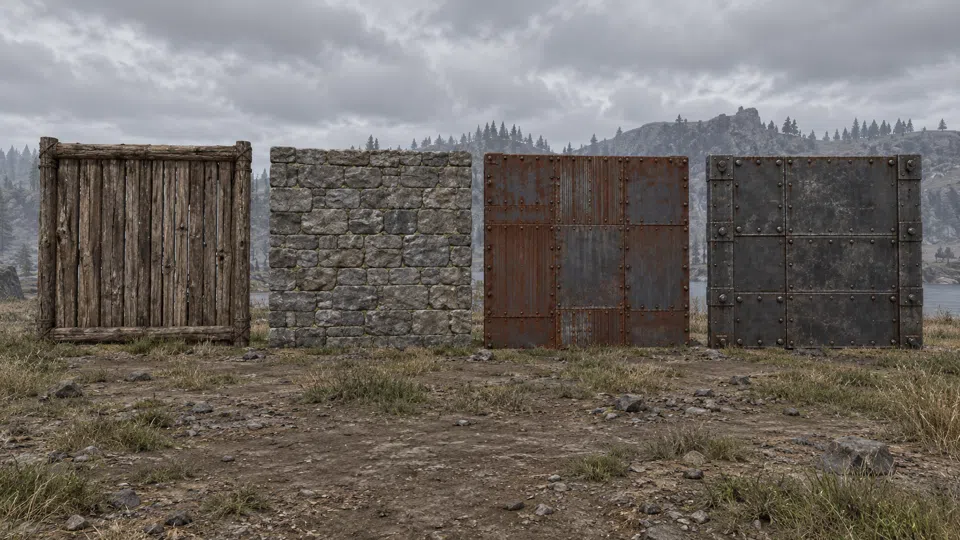
Know the grade before you count: planks, stone blocks, riveted sheets or thick armor plates.
Explosives needed from full health, outside the base. The highlighted cell is the option that costs the least sulfur.
| Target | HP | C4 | Rockets | Satchels | Explosive 5.56 | Beancans |
|---|---|---|---|---|---|---|
| Wooden Door, Wood Double Door | 200 | 1 | 1 | 2 | 18–19 | 7 |
| Sheet Metal Door, Sheet Metal Double Door | 250 | 1 | 2 | 4 | 63 | 21 |
| Ladder Hatch | 250 | 1 | 2 | 4 | 63 | 21 |
| Garage Door | 600 | 2 | 3 | 9 | 150 | 49 |
| Armored Door, Armored Double Door | 1,000 | 3 | 5 | 15 | 250 | 82 |
| Armored Ladder Hatch | 1,000 | 3 | 5 | 15 | 250 | 82 |
| Shop Front | 500 | 1 | 1 | 3 | 45–46 | 17 |
| Metal Shop Front | 750 | 3 | 6 | 18 | 300 | 99 |
| Wooden Window Bars | 250 | 1 | 2 | 3 | 48–49 | 18 |
| Strengthened Glass Window | 350 | 2 | 3 | 9 | 140 | 46 |
| Metal Window Bars, Reinforced Glass Window | 500 | 2 | 4 | 12 | 200 | 66 |
| Wood Wall | 250 | 1 | 2 | 3 | 48–49 | 18 |
| Stone Wall | 500 | 2 | 4 | 10 | 182–185 | 64 |
| Sheet Metal Wall | 1,000 | 4 | 8 | 23 | 399–400 | 131 |
| Armored Wall | 2,000 | 8 | 15 | 46 | 798–799 | 262 |
| High External Wooden Wall or Gate | 500 | 2 | 3 | 6 | 96–98 | 36 |
| High External Stone Wall or Gate | 500 | 2 | 4 | 10 | 182–185 | 64 |
| Tool Cupboard | 100 | 1 | 1 | 1 | 9–10 | 4 |
Every wall, door and deployable has its own page in the Rust raid calculator, and the calculator adds a whole raid up for you, cheapest way first.
Explosive 5.56 counts are for an Assault Rifle: the lower number from within 20 m, the higher from 100 m or more. Sulfur uses the higher number, rounded up to whole crafts of two rounds.
Each door, hatch and window has its own page here with a Raid cost table that also covers the rarer explosives, as on the Sheet Metal Door; each explosive's page lists what it destroys.
Walls
Stone is the wall you will face most, and two C4 is its cheapest answer at 4,400 sulfur. A sheet metal wall doubles that to four C4 and 8,800 sulfur. An armored wall takes eight C4, 17,600 sulfur, which is more than many small groups farm in a day, so look hard for a door or a weaker wall before you commit to one. High external stone walls and gates take the same as a stone wall; the wooden ones fall to 6 satchels or around 98 explosive rounds.
Doors and hatches
A sheet metal door and a ladder hatch both have 250 HP: one C4, two rockets, four satchels or 63 explosive rounds. A Garage Door (600 HP) takes three rockets or two C4. An armored door, armored double door or armored hatch (1,000 HP) takes three C4, five rockets or 250 rounds, more sulfur than a whole stone wall.
Windows and shop fronts
A Shop Front has 500 HP but is built like a wooden door, so a single rocket or C4 opens it and 46 explosive rounds do it for 1,150 sulfur. The Metal Shop Front (750 HP) is armored like a metal wall and takes three C4. Metal window bars and the reinforced glass window (500 HP) take two C4, the strengthened glass window (350 HP) 140 explosive rounds, and wooden bars fall like a wood wall.
Why does a stone wall take two C4?
A count is the target's health divided by what one explosive takes off it, rounded up. What it takes off depends on two things: the damage the explosive carries, and how much of each kind of damage the target's protection lets through.
| Explosive | Damage | Blast: full to none | Fuse | Dud chance |
|---|---|---|---|---|
| C4 | 550 explosion | Stuck to the target | 10 s | None |
| Satchel Charge | 75 explosion, 200 blunt, 200 stab | Stuck to the target | 6–12 s | 20% |
| Beancan Grenade | 15 explosion, 50 blunt, 50 stab | 1.5–4.5 m | 3.5–4 s | 15% |
| Rocket | 275 explosion, 75 blunt | 1–3.8 m | Fired | None |
| High Velocity Rocket | 30 explosion, 150 bullet, 300 anti-vehicle | 1–3.5 m | Fired | None |
| Explosive 5.56 round | 50 bullet, then a 5 explosion blast | 0–1.5 m (blast) | Fired | None |
| F1 Grenade | 100 blunt, 75 bullet, 50 anti-vehicle | 2–6 m | 2.5 s | None |
Against explosions, the targets fall into a few groups:
- Stone, sheet metal and armored, and with them metal window bars, glass windows and the metal shop front, take half of all explosion damage, so a C4 does 275 to each of them. Sheet metal and armored hold out longer only because they have more health.
- Metal doors, hatches and the garage door take 80%, 440 from a C4.
- Wood walls, wooden bars and wooden high walls take 90%, 495 from a C4.
- Wooden doors, the shop front and the tool cupboard take double: 1,100 from a C4. That is why one satchel destroys a cupboard and a single rocket opens a shop front.
Every target here is fully protected against anti-vehicle damage, and walls let through only a sliver of bullet damage: 1% on stone, almost none on sheet metal, none at all on a metal door. Most of what a high velocity rocket or an F1 grenade carries is lost before it lands.
Then there is the side. A wall's outer, hard side cuts blunt and stab damage by 90% and bullet damage by half, but not explosion damage. Rockets, grenades and explosive rounds hit from outside and meet it; C4 and satchels are stuck to the wall and skip it. For C4 the side changes nothing, since it is all explosion, but a satchel keeps its blunt and stab: they are 14 of the 51.5 damage it does to stone. Doors, windows, high external walls and the cupboard have no soft side at all.
Put together, here is what one of each does to a 500 HP stone wall, and what each point of that damage costs:
| Explosive | Damage to stone | Needed | Sulfur per point |
|---|---|---|---|
| C4 | 275 | 2 | 8.0 |
| Explosive 5.56 round | 2.75 within 20 m, 2.70 at 100 m | 182–185 | 9.1–9.2 |
| Satchel Charge | 51.5 | 10 | 9.3 |
| Rocket | 137.65 | 4 | 10.2 |
| High Velocity Rocket | 15.75 | 32 | 12.7 |
| Beancan Grenade | 7.85 | 64 | 15.3 |
| F1 Grenade | 0.575 | 870 | 104 |
C4 has the best rate on stone, which is the whole case for it on walls. The rate is not the full bill, though, because counts round up. Two C4 deal 550 to a 500 HP wall and waste 50. On a 250 HP wood wall a single C4 deals 495 and wastes almost half, so 49 explosive rounds, which never overshoot by more than one round, come out cheaper.
Explosive 5.56: 20 m or 100 m
Each explosive round hits twice: the bullet, then a small blast of 5 explosion damage. With an Assault Rifle the bullet does its full 50 within 20 m and drops to 80% at 100 m. On stone, only 1% of the bullet gets through and the hard side halves that, so it adds 0.25 per round up close and 0.20 from 100 m, against 2.5 from the blast. That small difference is the gap between 182 and 185 rounds. A metal door takes no bullet damage at all, so on metal doors only the blast counts, 4 per round, and the count is the same at any range: 63 for a sheet metal door.
Which explosive is the cheapest for each target?
Set the sulfur against the damage and the pattern is simple:
- Stone, sheet metal and armored walls: C4. Two C4 on stone cost 4,400 sulfur, against 4,650 in explosive rounds, 4,800 in satchels and 5,600 in rockets.
- Doors, hatches, glass windows, shop fronts and anything wooden: explosive 5.56. A garage door costs 3,750 sulfur in rounds, 4,200 in rockets and 4,400 in C4.
- Metal window bars and the metal shop front: C4 again, 4,400 sulfur for two on the bars.
- The tool cupboard itself: 10 explosive rounds, 250 sulfur. Never spend a C4 on it.
The cheapest option is not always the right one. Explosive ammo means standing at a door through hundreds of shots that tell the whole area a raid is on. C4 is over in seconds by comparison, and rockets let you work from behind cover when the base shoots back. Most raids end up mixed: rockets or C4 to open the outer layer fast, explosive rounds for the inner doors and the cupboard.
Explosive 5.56, in short:
Pros
Cons
- Cheapest in sulfur on every door, hatch and wooden target
- Fired from a distance, nobody stands at the wall
- Leftover rounds carry over to the next target, so nothing is wasted on a wall that is almost down
- Hundreds of rounds per target: 250 for an armored door
- Slow and loud, the defenders have time to respond
- Needs a rifle and a Level 3 workbench
What about HV rockets, 40mm grenades, MLRS and fire?
The five explosives in the chart are the ones raids are built on. The rest either lose most of their damage to a building's protection or cannot be researched. Here is what they take, from full health with direct hits:
| Target | HV Rockets | 40mm HE | MLRS Rockets | F1 Grenades |
|---|---|---|---|---|
| Wooden Door | 4 | 3 | 1 | 85 |
| Sheet Metal Door | 11 | 9 | 1 | 500 |
| Garage Door | 25 | 22 | 3 | 1,200 |
| Armored Door | 42 | 36 | 4 | 2,000 |
| Wood Wall | 9 | 8 | 1 | 189 |
| Stone Wall | 32 | 29 | 3 | 870 |
| Sheet Metal Wall | 67 | 57 | 6 | 9,638 |
| Armored Wall | 134 | 114 | 12 | 19,276 |
| Tool Cupboard | 2 | 2 | 1 | 43 |
High velocity rockets cost 200 sulfur and a Level 2 workbench, but only their 30 explosion damage really lands on a building. That still makes them cheaper than regular rockets on wooden doors (800 sulfur against 1,400), wood walls (1,800 against 2,800), sheet metal doors (2,200 against 2,800) and the cupboard (400 against 1,400). On a garage door, stone and anything heavier they cost more.
40mm HE Grenades and MLRS Rockets hit hard: a 40mm grenade carries 35 explosion and 55 blunt damage, and an MLRS rocket 350 explosion damage at full strength anywhere within 10 m of where it lands. Three MLRS rockets break a stone wall and one opens any wooden or sheet metal door. Neither can be researched, so you raid with the ones you loot, not the ones you plan.
F1 grenades carry no explosion damage at all, and the hard side strips the blunt and bullet damage they do have. At 870 grenades for a stone wall, they are for players, not walls.
Fire cannot raid a stone base. The Incendiary Rocket (50 heat) and the Molotov Cocktail (35 heat) deal only heat damage, and stone, sheet metal and armored walls, metal doors, hatches, metal window bars and glass are fully protected against heat. Fire only burns wooden targets, and it burns over time, which the counts here do not model, so there is no fire number in this article.
How much sulfur do you need to raid a whole base?
A base is a route, not a single wall. Count every door and wall between the outside and the Tool Cupboard or the loot room, pick the cheapest way through each, and add them up. A typical 2x2 with an airlock means a sheet metal door, a garage door and the cupboard. A compound adds a high external wall and often an armored door on top.
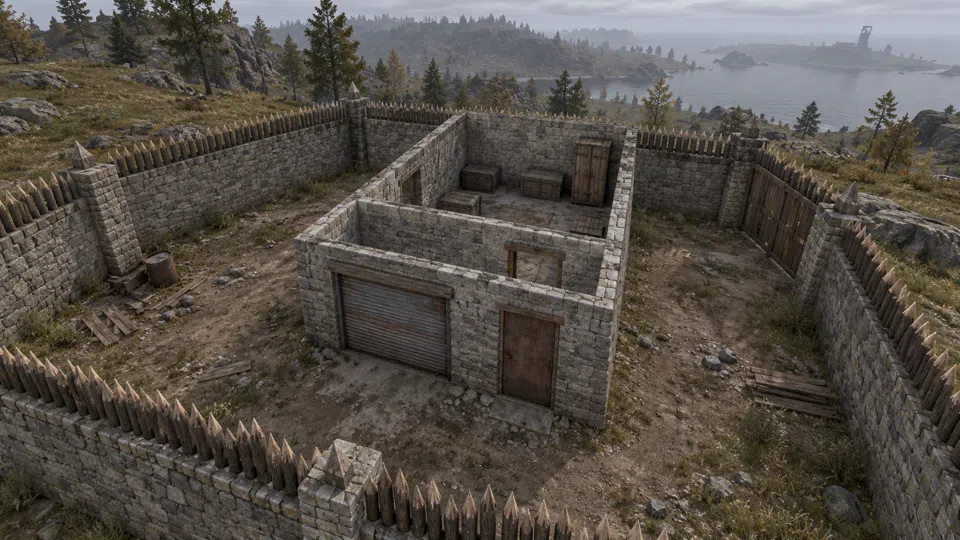
Every layer between the outside and the loot is a line on the bill.
Raid route calculator
This calculator needs JavaScript. The raid chart above has every number it uses.
Add what stands between you and the loot, in order. Start from a preset or build your own. Double doors and gates count as their single door and wall.
Your route
| Use | How many | Sulfur | Compared |
|---|---|---|---|
| C4 only | 0 | 0 | |
| Rockets only | 0 | 0 | |
| Satchels only | 0 | 0 | |
| Explosive 5.56 only | 0 | 0 | |
| Beancans only | 0 | 0 | |
| Cheapest mix | 0 | 0 |
The cheapest mix, layer by layer
Explosive rounds are crafted in pairs, so the totals round them up once for the whole route.
Then plan the raid itself:
- Walk the outside and note the grade of every wall and the type of each door you can see.
- Find the shortest line to the loot room or the cupboard. A doorway and one inner wall are usually cheaper than three walls in a row.
- Put that route into the calculator, take the cheapest mix and add spare charges for misses.
- Craft well ahead at a Level 3 workbench: a rocket takes 5 seconds and a C4 30 seconds per craft, on top of the explosives and gun powder inside them.
- Bring building materials, so you can wall yourself in once you reach the loot.
How to raid for less sulfur
Go through doors, not walls. A sheet metal door costs 1,600 sulfur in explosive rounds; the stone wall beside it costs 4,400 in C4. A garage door is still cheaper than the stone wall around it.
Look for the weak spot. Builders upgrade the walls people see and forget the rest. A wooden door, a shop front, one stone wall on an otherwise metal base or a ladder hatch on the roof can halve the route.
Aim rockets at the wall itself. A rocket deals full damage only within 1 m of where it bursts and nothing past 3.8 m. One that bursts 2.4 m from a stone wall does about 69 damage instead of 138, half a rocket gone.
Watch for decay. A base whose tool cupboard has run out of upkeep loses health over time, so its walls need fewer charges the longer it sits.
Tip
When a wall survives your last charge with a sliver of health, finish it with explosive rounds instead of another C4. A handful of rounds costs a fraction of the 2,200 sulfur a charge does.
Watch out
One satchel charge in five and about one beancan grenade in seven fail to go off. On a stone wall that needs ten satchels, bring two or three spare, or the raid stalls one wall short.
FAQ
How many rockets for a stone wall?
Four rockets, 5,600 sulfur. Two C4 do the same for 4,400 sulfur, so rockets only pay off when you need range.
How much sulfur is one C4?
2,200. A C4 takes 20 Explosives at 110 sulfur each, plus cloth and tech trash.
How many C4 for an armored door?
Three C4, 6,600 sulfur. Five rockets cost 7,000, and 250 explosive rounds cost 6,250.
How many satchels for a sheet metal door?
Four satchel charges, 1,920 sulfur. One satchel in five is a dud, so bring a spare.
Is it cheaper to raid with rockets or C4?
C4 on every wall. A rocket costs less than a C4 but does less damage for each sulfur spent: 10.2 sulfur per point of damage on stone against 8.0 for C4, so it wins only on range and safety.
Can an incendiary rocket break a stone wall?
No. It deals only heat damage, and stone, sheet metal and armored walls and every metal door are fully protected against heat. It can only burn wooden targets.